If you live in South Devon, you have almost certainly met limescale, even if you did not know its name. It is the chalky white crust that creeps around your taps, the cloudy film on your shower screen that will not wipe away, the strange flakes in the bottom of your kettle. It is not a sign of a dirty home and it is not your fault. It is simply the inevitable result of our hard water, and once you understand it, you can actually do something about it. Sometimes a change of habits is enough. Sometimes a proper deep clean is what it takes to reset surfaces that have been losing the battle for months. Here is what is going on beneath that white crust, and how to win the long-running battle against it.
Why South Devon has hard water
Hard water is water that carries a high level of dissolved minerals, mainly calcium and magnesium, picked up as it passes through the ground. Here in South Devon our water is on the harder side, which is wonderful for a nice cup of tea but rather less wonderful for your bathroom and kitchen. Every time hard water sits and evaporates on a surface, it leaves those minerals behind as a hard, chalky deposit. That deposit is limescale, and because we are running water over the same taps, screens and fittings many times a day, it builds up relentlessly.
Where limescale loves to build
Limescale is predictable, which is at least helpful. It forms wherever hard water regularly sits, drips or dries. The usual culprits are:
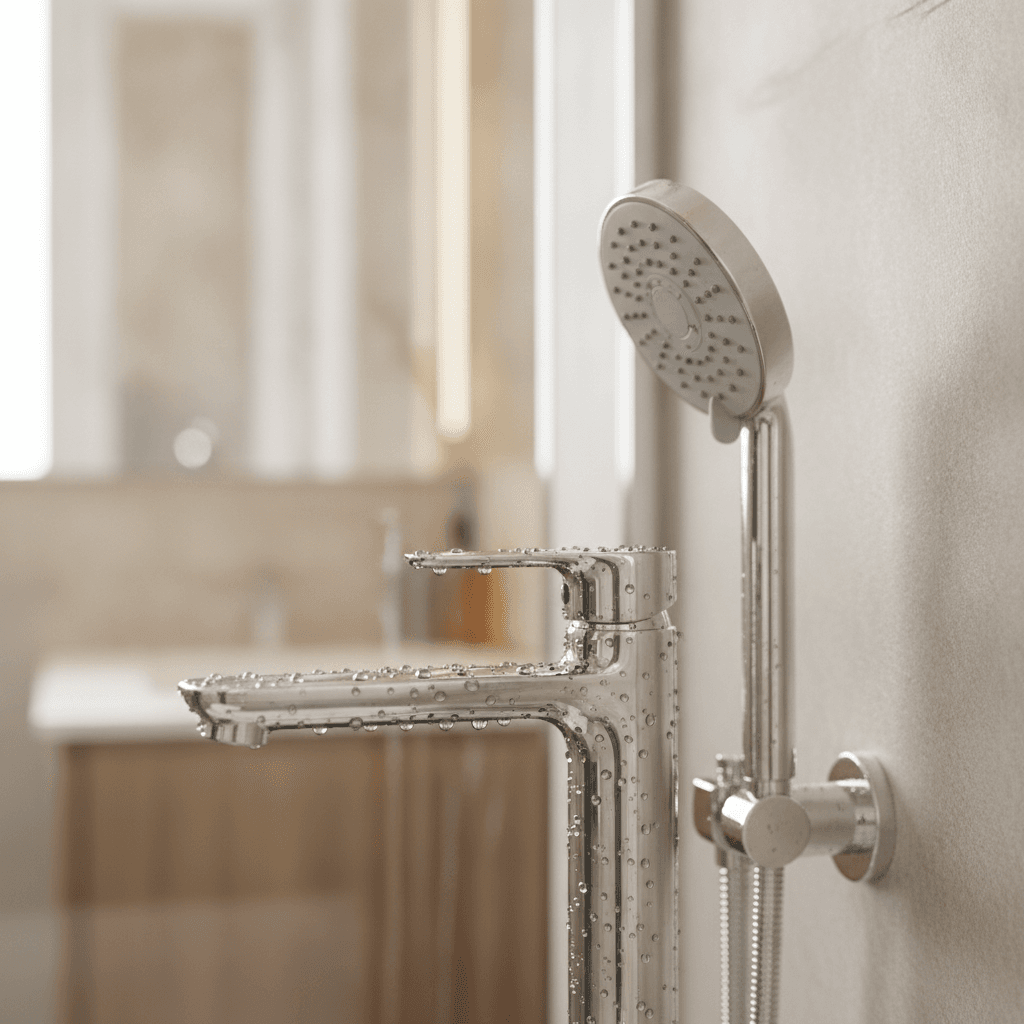
- Taps.Around the spout, the base and the handles, where water pools and dries.
- Showerheads.Blocking the little holes, weakening the spray and leaving the head crusted.
- Glass shower screens.That stubborn cloudy film that makes glass look permanently dirty no matter how you wipe it.
- Kettles.The flakes and chalky coating inside, which can affect the taste of your water and the kettle's efficiency.
- Tiles and grout.A dulling film across tiled walls and a build-up along grout lines.
- Toilets.Below the waterline and around the rim, where it can cause discolouration over time.
Why ordinary wiping does not remove it
Here is the frustrating part that catches so many people out. You can scrub a limescaled tap with your usual spray and cloth as hard as you like and barely make a dent. That is because limescale is a mineral deposit, not dirt sitting on the surface. It has effectively bonded to the surface, and ordinary cleaning products are simply not designed to break it down. To actually dissolve limescale you need something mildly acidic, because acid reacts with and breaks apart the mineral deposit in a way that elbow grease alone never will. Wiping moves dust and grime. Limescale needs to be chemically loosened before it will let go.
How to tell light build-up from heavy build-up
Not all limescale is the same, and treating a heavy deposit the same way you would treat a light one leads to disappointment. Knowing where your problem sits helps you choose the right response.
Light build-up is a thin, slightly chalky film, often a milky haze on glass or a faint whitening around the base of a tap. At this stage the deposit has not fully hardened and responds well to a short dwell time with a limescale remover. This is what regular cleaning keeps in check.
Moderate build-up is a clearly visible white or cream crust, often with some texture you can feel with a fingernail. It may have been forming for several weeks or months. It will still come away with proper treatment, but it needs a longer contact time and may need a second application.
Heavy or established build-up is a thick, rough crust that can be several millimetres deep in places. You often see it on taps in a property that has been empty for a while, on showerheads that have never been descaled, or on toilet bowls where discolouration has moved into the ceramic itself. This is the stage where a deep clean, with professional-grade products and the time to do the job properly, makes a genuine difference to what is achievable.
Practical removal tips
The good news is that, treated correctly, limescale comes away. A few approaches that genuinely work:
- Use an appropriate limescale remover or a mild acidic solution, and crucially, give it time to work rather than wiping it straight off. Let it sit so it can break down the deposit.
- For showerheads, soaking the head so it is fully submerged lets the solution get into every blocked hole.
- For taps, wrapping the treatment around the fitting and leaving it in contact for a while works far better than a quick wipe.
- On glass screens, repeated treatment may be needed for heavy build-up, and finishing with a squeegee after each shower stops it returning.
- Always rinse thoroughly afterwards, and take care with the surface itself, as some finishes do not react well to acidic products. When in doubt, test a small area first.
What we actually see in South Devon homes
Because we clean homes across Torbay and South Devon every day, we see the same patterns repeat. Shower screens tend to be the worst offenders, partly because people often assume that the shower spray rinses them clean. It does not. Every shower deposits a fine layer of minerals, and without a squeegee or a wipe-down, those layers compound. By the time a screen looks cloudy, there is usually months of build-up to shift, not days.
Taps around the bath spout are another consistent problem. Water drips from the spout after every bath or rinse, pools around the base of the fitting and dries there. Over months, that produces a thick collar of limescale that sits right where the tap meets the surface, sometimes lifting slightly at the edges and trapping grime underneath as well as on top. Getting into that gap properly takes the right tool and the patience to let the product do its work.
Toilets are easy to overlook. The limescale that forms below the waterline and under the rim is out of sight and easy to ignore until it has calcified into a brown or orange-tinged ring that looks far worse than it is. It is still mineral deposit, and it still responds to an acidic treatment, but it needs to dwell properly rather than being flushed away within seconds of application.
One thing we notice repeatedly on deep cleans is that people have been working hard but working against themselves, scrubbing with products that are simply not the right chemistry for the job. Effort without the right product does not make a dent on established limescale. It can actually make some surfaces look worse by leaving marks while leaving the deposit untouched.
Prevention: keeping it from coming back
Removing limescale is satisfying, but stopping it forming in the first place is even better. The single most effective habit is keeping surfaces dry, because limescale needs standing water to form. A few simple routines make a real difference:
- Wipe or squeegee the shower screen and tiles after each use, so the hard water never gets the chance to dry and deposit.
- Dry around taps and the sink after heavy use rather than leaving puddles to evaporate.
- Deal with early build-up quickly, while it is a light film, rather than waiting until it is a hard crust that takes real effort.
- Keep the kettle descaled regularly rather than once a year.
None of this is dramatic, but done consistently it keeps limescale on the back foot rather than letting it establish.
How professional cleans target limescale
Staying ahead of limescale is exactly the kind of steady, knowledgeable attention that a professional clean is built for. As a local South Devon team, we deal with hard water and limescale every single day, so we know precisely where it hides and how to shift it. On a regular clean, we keep limescale in check before it has a chance to set hard, treating taps, screens and surfaces consistently so it never reaches that stubborn, crusted stage. On a deep clean, we go further, dedicating proper time to removing established build-up from taps, showerheads, screens, tiles and toilets, bringing fittings back to life that may have looked permanently dulled.
Limescale also matters enormously for end of tenancy cleans. When you are moving out, calcium-crusted taps and a cloudy shower screen are exactly the kind of thing a letting agent will notice on an inspection. A proper end of tenancy clean specifically targets all that mineral build-up, getting bathrooms and kitchens back to the standard expected at handover. And to be clear about our policy, if your letting agent flags anything within 48 hours of the clean, we come back and put it right at no extra charge. Our cleaners are DBS checked and fully insured, and we bring the professional products needed to tackle hard water properly, or your own or eco-friendly products on request.
We cover homes across the area, from Torquay and Paignton to Totnes, Newton Abbot and the South Hams villages. If you are not sure whether we reach you, our areas we cover page has the full picture.
Frequently asked questions about limescale in South Devon
Can limescale permanently damage my taps or shower screen?
In most cases, no, but left long enough it can cause problems. On chrome taps, very thick limescale deposits can trap moisture against the metal and contribute to pitting or corrosion underneath over time. On glass shower screens, severe etching can occur if an acidic build-up is left in contact with the glass for a prolonged period, or if the wrong cleaning product is used repeatedly. In practice, the damage most people see is cosmetic and reversible with proper treatment, but the longer heavy build-up is left, the harder the job becomes and the greater the risk of surface marks that cannot be fully reversed.
Is it safe to use vinegar on all bathroom surfaces?
Diluted white vinegar is a popular home remedy for limescale, and it does work on many surfaces because of its mild acidity. However, it is not suitable for everything. Natural stone surfaces such as marble, travertine or slate can be etched or dulled by acidic products, including vinegar. Some chrome finishes and plated taps can also be affected by repeated or prolonged exposure. Grout can be weakened if acidic solutions soak in regularly over time. If you are not sure what your surfaces are made of, test a very small, inconspicuous area first and do not leave acidic products on any surface longer than the instructions suggest.
How often should I be descaling in a hard water area?
For daily-use items like a kettle, descaling every four to six weeks is reasonable in a hard water area. For shower screens and tiles, the squeegee-after-every-use habit is more effective than periodic descaling treatments on their own. For taps and showerheads, a proper descaling treatment once a month keeps light build-up from becoming heavy build-up. If you have a regular professional clean, that maintenance is folded in for you. If you are starting from a neglected position, a one-off deep clean first makes the ongoing maintenance far more manageable.
Will a deep clean remove all the limescale even if it has been building up for years?
A deep clean can shift a very large amount of established limescale and restore surfaces that look beyond help. In most cases the results are dramatic. There are some limits: if limescale has been present for many years on a surface that was already scratched or damaged, those underlying marks will still be there once the scale is removed. In rare cases, discolouration can penetrate the glaze of older sanitaryware. But in our experience, surfaces that look hopeless very often come back well with the right products and proper dwell time. The honest answer is that it is worth trying before assuming a fitting needs replacing.
Do I need a deep clean, or will a regular clean sort the limescale?
It depends on where you are starting from. If your limescale is at the light or moderate stage, a regular professional clean will keep it under control and gradually improve things visit by visit. If you have heavy, established build-up on multiple surfaces, a one-off deep clean first makes more sense. It clears the backlog properly, so the regular clean that follows is doing maintenance rather than restoration. Many customers book a deep clean to reset a bathroom or kitchen that has got away from them, then move to a regular clean to keep it that way.
Limescale is a fact of life in South Devon, but a permanently cloudy shower screen does not have to be. With the right treatment, a few good habits and a bit of regular help, you can keep your home's taps, screens and tiles genuinely gleaming. If the hard water has got ahead of you, or you simply would rather hand the limescale battle over to someone who fights it every day, we are here to help. For a free, no-obligation quote, call our friendly local team on 01803 500721 and let us get your home sparkling again.
Want a hand with your home?
Get a free, no-obligation quote from our friendly local team.