Totnes wears its history openly. Walk up the steep medieval high street, slip through The Narrows, and you are surrounded by buildings that have stood for centuries, timber framed, stone built, full of the gentle irregularities that come with age. To own a period or listed home in a town like this is a privilege, and a responsibility. These houses were built with materials and methods quite unlike a modern home, and they ask to be cleaned and cared for accordingly. If you are looking for home cleaning in Totnes that genuinely understands older properties, you are in the right place. As a local, family-run cleaning business, we have a deep respect for older homes, and we want to share how to keep them beautiful without doing them harm.
Why old homes need a different approach
The single most important thing to understand about a period property is that it was designed to breathe. Lime plaster, original timber, old stone and traditional paints all manage moisture in a way modern sealed surfaces do not. The harsh, all-purpose chemicals and aggressive scrubbing that suit a new bathroom can strip, stain or slowly damage these older materials. The guiding principle is simple: gentler is almost always better. Less product, softer cloths, and patience rather than force.
In practice, this means thinking about each surface individually before you reach for a cloth. A modern kitchen worktop and a seventeenth-century oak beam are not the same material and they do not want the same treatment. The first thing we do in any period home is take stock of what is original, what has been restored, and what has been replaced at some point over the years, because those three categories often need quite different handling.
What home cleaning in Totnes actually involves in a period property
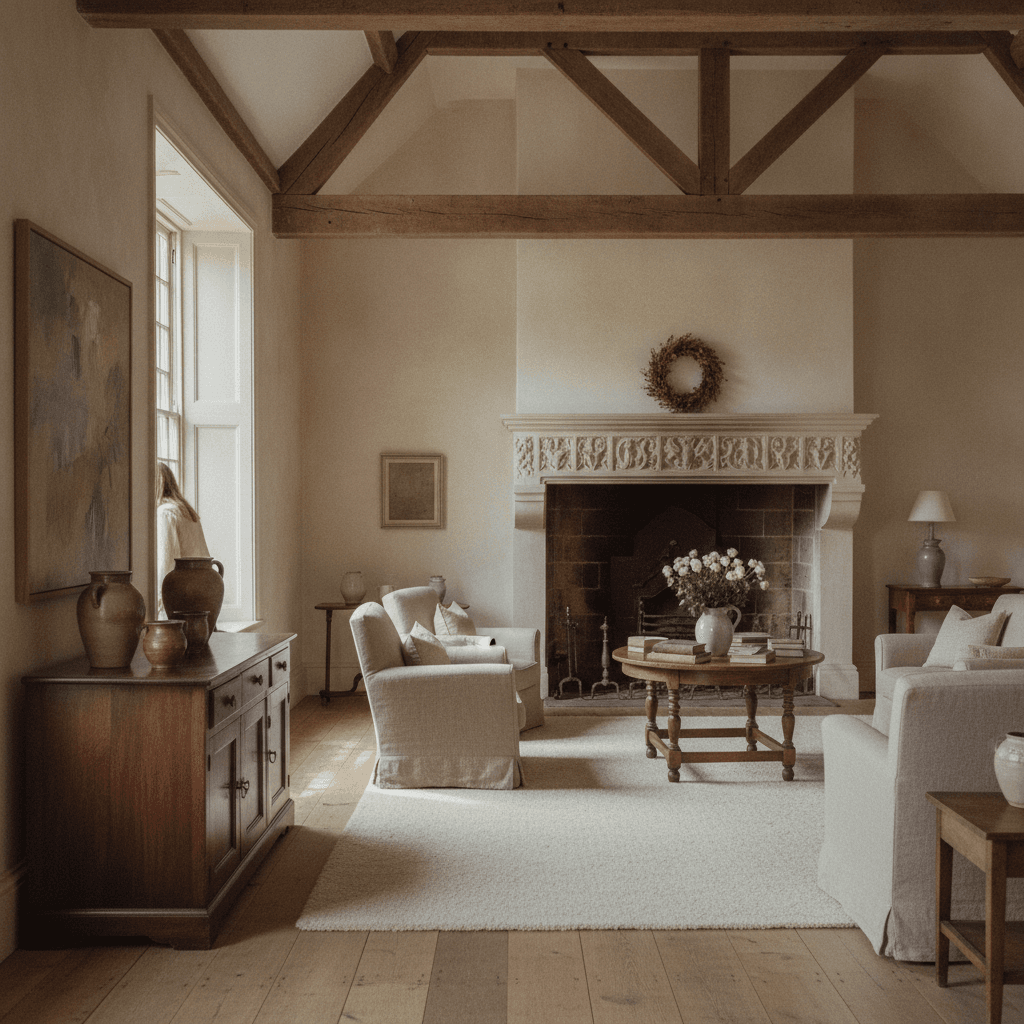
When we clean a period home in Totnes, the job looks different from cleaning a modern house, and it takes longer. Original features gather dust in ways smooth, flat surfaces do not. Carved cornicing, deep window reveals, uneven plaster walls, inglenook fireplaces, flag-stone hearths and aged joinery all have corners and crevices that need careful attention with a soft brush rather than a cloth dragged across them. Rushing that stage means moving dust around rather than removing it.
We also pay attention to what is behind and underneath. Period properties can have flagstone or quarry tile floors under rugs, lime-washed walls behind furniture, and original skirting boards that have not been repainted in decades. Moving carefully around these things, rather than nudging furniture into them, is part of how a considered clean protects a home over time.
Exposed beams and original timber
Those wonderful old beams are often one of the first things to gather dust, and one of the easiest to mistreat. Most original timber wants nothing more than gentle dusting with a soft, dry cloth or a soft brush to reach the carved and uneven sections. Soaking old wood with water or wet sprays is best avoided, as is any harsh polish that builds up an unnatural sheen. The aim is to lift dust and cobwebs while leaving the timber's natural surface and patina untouched.
One thing people often overlook is the junction between old beams and the plaster or stonework around them. These joints are where moisture can sit if a wet cloth is used too freely, and trapped moisture at those points is a slow route to both timber decay and plaster damage. A dry or barely damp cloth, kept well away from the joint itself, is the right tool here.
Original wood and stone floors
Old floors are survivors, but they are not invincible. A few principles serve them well:
- Sweep or vacuum first.Grit is the enemy of an old floor, acting like sandpaper underfoot. Removing it before any cleaning protects the surface.
- Go easy on water.Original wood and many old stone and tile floors dislike standing water. A barely damp mop, wrung out well, is far kinder than a wet one.
- Avoid harsh or acidic cleaners on stone.Natural stone, slate and old tiles can be dulled or etched by strong products. Gentle, suitable cleaners keep them looking right.
It is also worth being aware that many old stone and quarry tile floors were never sealed in the modern sense. They were simply kept clean and occasionally treated with wax or natural oils. Applying a modern sealant product without understanding what is already on the surface can trap moisture underneath and cause long-term problems. If you are uncertain about the history of your floor, a specialist in period materials is worth consulting before you change anything.
Sash windows and old glass
Sash windows are a joy and a quirk. The timber frames and the old, sometimes original glass need a soft touch. We clean the glass gently and keep moisture away from the timber and the joints as much as possible, since trapped damp is what causes frames to deteriorate. Care around the catches and cords matters too, as these are working parts that have often been in place for a very long time. In Totnes, with its coastal South Devon air, condensation gathers readily on old windows, so keeping sills clean and dry helps protect them through the damper months.
Old glass is thinner and more varied in its surface than modern float glass. It can be cleaned with a gentle, diluted glass cleaner and a soft cloth, but abrasive materials should never go near it. The slight imperfections and waviness in original glass are part of its character, and fine scratches, once made, cannot be undone.
Lime plaster and old paintwork
Lime plaster and traditional paints are some of the most easily damaged surfaces in a period home, and some of the most commonly mistreated. They do not respond well to wet wiping or scrubbing, which can mark, smear or break the surface. Gentle dry dusting is usually the safest route, and any spot that genuinely needs more attention is best approached cautiously and tested first. The same goes for old painted woodwork and panelling, where a light hand preserves a finish that modern cleaning can quickly ruin.
A common mistake we see is people using damp microfibre cloths on lime-washed or distempered walls because they look dusty. The dust lifts, but so can the surface layer of the paint beneath it. In a listed building, repairing that kind of damage to an original finish is not straightforward. Dry dusting with a very soft brush, working from the top of the wall downwards, is a much safer habit to form.
Hard water in an old home
South Devon's hard water is no respecter of age, and limescale builds up on the taps, kettles and bathroom fittings of a period home just as it does anywhere else. The difference is that older fittings, and the surfaces around them, often need a more careful touch than a modern suite. We deal with limescale using suitable products and gentle methods, so that taps and tiles come up clean without the surrounding original materials taking any punishment in the process.
Cast-iron baths, original ceramic sinks and old brass or chrome fittings each have their own tolerances. Strong acid-based descalers, which work quickly on modern chrome, can pit, dull or permanently mark older metal surfaces and original enamel. Patience with a gentler product, left to dwell for longer, is nearly always the better route.
What to avoid
A short list of things that do more harm than good in an older home:
- Strong bleach and harsh all-purpose sprayson old stone, timber, lime plaster and traditional paint.
- Acidic cleanerson natural stone and old tile floors.
- Lots of wateron original wood, plaster and timber frames.
- Abrasive pads and hard scrubbingon any original surface.
- Heavy silicone polishesthat build up and mask the natural character of old wood.
Why a careful, knowledgeable hand matters
The truth is that a period home rewards the person who slows down and pays attention. Knowing which surface is original, which product is safe, and where a gentle touch is needed is what separates a clean that protects a home from one that quietly wears it away. Wherever it is practical, the same trusted cleaner returns to your home each visit, which means they come to understand your particular house, its delicate features and the things that matter to you. Every member of our team is DBS checked and fully insured, and while we bring professional products as standard, we are very happy to use your own or eco-friendly products, which often suit older homes beautifully. If anything is ever flagged with us within 48 hours of a clean, we will put it right at no extra charge.
You can read more about how we work on our about our family-run team page. We also offer Regular Cleaning and Deep Cleaning services, both of which can be tailored to the specific needs of an older property.
FAQ: home cleaning in Totnes for period properties
Can you clean a listed building without risking damage to protected features?
Yes, provided the approach is right. Listed building consent relates to alterations and works, not to routine cleaning, but the spirit of it applies: you should not be doing anything that damages or removes original material. Using gentle products, avoiding excess water and treating each surface individually is how a careful cleaning team works safely in a listed home. If there is any doubt about a particular surface or feature, the right response is to leave it and discuss it with the homeowner rather than press on.
How often should a period home be cleaned professionally?
For most people, a regular fortnightly clean works well, with a more thorough one-off deep clean once or twice a year to reach the things that accumulate over time: behind furniture, above door frames, inside window reveals and around fireplaces. Older homes tend to gather dust more readily than modern ones because of their uneven surfaces and natural materials, so more frequent visits can make a real difference to both the look of the home and the long-term condition of its surfaces.
Do you bring your own products, or should I provide specialist ones for my old home?
We bring professional products as standard, and we are experienced in choosing the right one for different surfaces. If your home has particularly delicate or unusual original features, or if your conservation officer or builder has recommended specific products, please do tell us. We are happy to use your preferred products instead, and we find that many eco-friendly or pH-neutral options suit period materials very well.
Is an end of tenancy clean possible in a period property, including listed buildings?
Yes. We carry out end of tenancy cleaning in Totnes in all types of property, including older and listed homes. The same careful approach applies: we work methodically through the property, using appropriate products for each surface, and we take extra care around anything original or particularly delicate. It is always helpful to let us know in advance if the property has specific features that need particular attention.
What if a cleaner notices something that looks like damp or damage during a visit?
We will always mention it. One of the practical benefits of having the same cleaner return regularly to a period home is that they get to know the property well enough to notice when something has changed, a new patch of discolouration on a plaster wall, a window sill that is wetter than usual, or a floor that is lifting slightly. We are not surveyors, and we will not diagnose the cause, but we will flag it promptly so you can investigate. In an older home, catching a damp issue early can make a considerable difference.
Looking after Totnes's heritage homes
The period and listed buildings of Totnes are part of what makes the town so special, from the houses lining that steep high street to the characterful spaces tucked along The Narrows. They deserve home cleaning in Totnes that treats them as the irreplaceable homes they are. Whether you would like regular house cleaning, a careful one-off deep clean or an end of tenancy clean, we would be glad to help you care for yours properly. Call us for a friendly chat and a free quote on 01803 500721.
Want a hand with your home?
Get a free, no-obligation quote from our friendly local team.